
Most small businesses in Saudi Arabia already have a CRM. It is just spread across WhatsApp chats, an Excel sheet, a notebook on the reception desk and the memory of whoever answered the phone. The question is not whether you track leads. It is whether the way you track them loses customers.
The short answer: choose a CRM after you have written down how a lead moves through your business, not before. Then check five things: it captures leads from WhatsApp, calls and your website in one place, works well in Arabic and on a phone, reminds your team to follow up, reports where each client came from, and lets you handle customer data the way Saudi Arabia's Personal Data Protection Law expects.
What does a CRM do for a small business?
A CRM is the system that stores every lead and tracks each follow-up. Each inquiry becomes one record, with the person's details, where they came from, what they asked for and what happens next. Your team stops asking "did anyone reply to this?" because the answer is on the screen.
For a small business, that matters more than the long feature lists suggest. A small team rarely loses leads because it lacks a forecasting module. It loses them because a WhatsApp message arrived on a busy afternoon and nobody wrote it down.
"Small" has an official meaning here. Monsha'at defines a small enterprise as one with 6 to 49 full-time employees or revenue of SAR 3 million to 40 million. That is the size this guide has in mind: a few people handle sales, and the owner is often one of them.
Do you need a CRM yet?
You probably do if two or more of these are true:
- Leads arrive through more than one channel, for example WhatsApp, phone calls, Instagram messages and a website form.
- More than one person replies to customers, and they don't always know what the others said.
- You can't say how many inquiries came in last month, or how many became clients.
- Follow-ups depend on memory. If the person who took the call is on leave, the lead waits.
- You pay for ads and can't tell which campaign brought the clients who actually paid.
You may not need one yet if you get a handful of inquiries a month and one person handles all of them. A well-kept shared sheet can be enough at that stage. Move to a CRM when the sheet starts to fall behind.
What should you map before you choose?
Write your sales process on one page before you look at any product. It takes an hour, and it decides which CRM fits. Answer four questions:
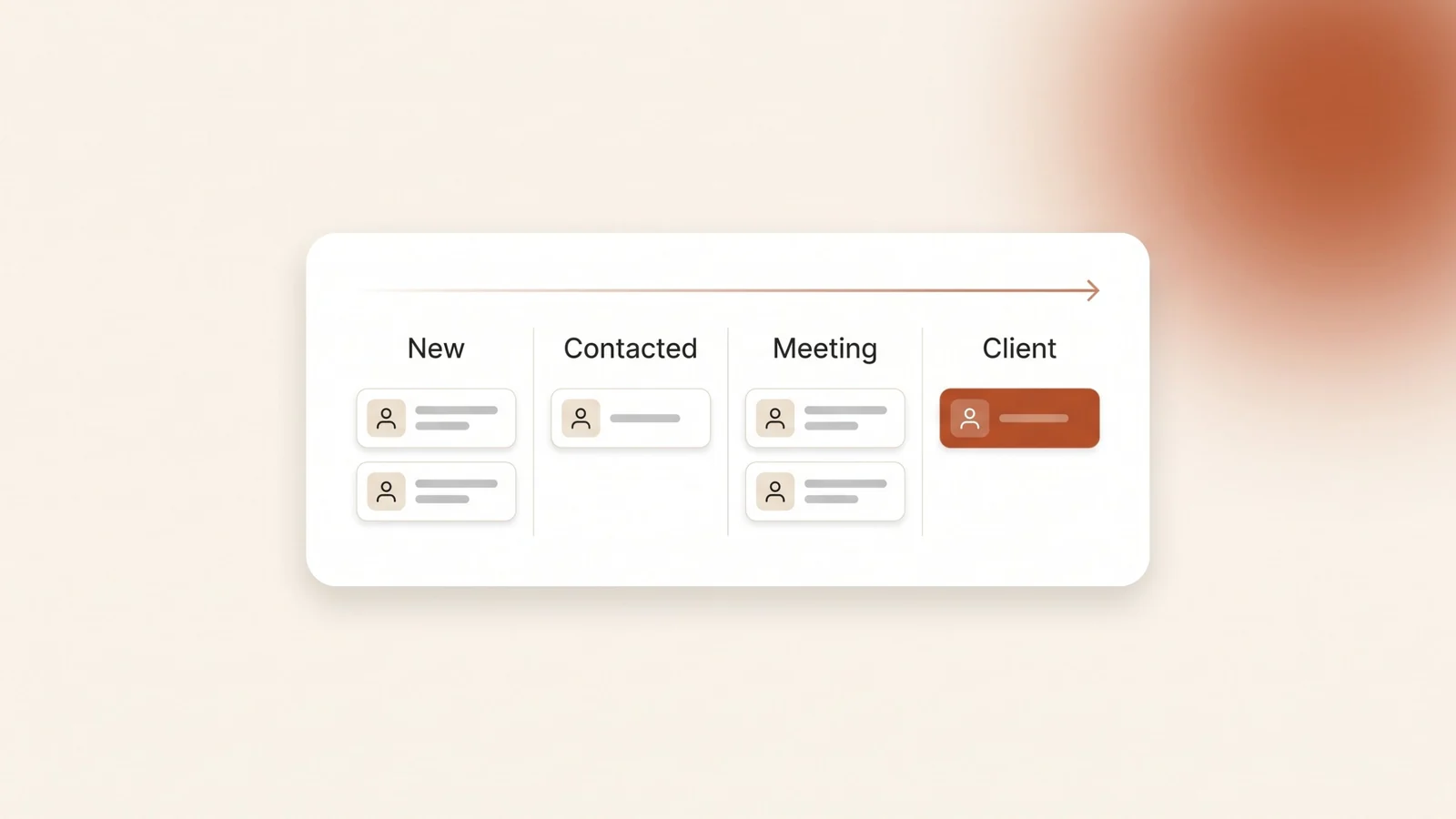
- What are your stages? Keep them few and clear, for example New, Contacted, Meeting, Client. Each stage should describe something that happened, not a feeling about the lead.
- Where do leads come from? List every source: WhatsApp, calls, the website, Google Ads, walk-ins, referrals.
- Who owns each lead? One named person per lead. Shared ownership usually means no ownership.
- What is your follow-up rule? For example: reply to new leads the same working day, follow up after two days, close the lead after a set number of tries.
A real estate office, a clinic and a law firm will write very different pages. That is the point. The CRM should fit the page, not the other way round. Our page on real estate agencies shows how this looks in one sector.
Which CRM features matter in Saudi Arabia?
Most CRMs can store contacts and show a pipeline. The differences that matter for a Saudi small business are in the details below. Ask about each one in a demo, and ask to see it working, not described.
| Feature | Why it matters | What to ask |
|---|---|---|
| WhatsApp connection | If customers message you on WhatsApp, those chats should land in the CRM, not only on one phone | Can messages be sent and logged from the CRM? Which WhatsApp product does it use? |
| Arabic and right-to-left | Staff and customers write in Arabic, and names may be saved in Arabic or English | Does the interface work in Arabic? Can I search an Arabic name and find its English spelling? |
| Mobile use | If your team works from phones between visits and calls, the CRM has to work there too | Can a lead be added and updated from a phone in under a minute? |
| Lead capture | Leads typed in by hand get missed on busy days | Do website forms, calls and ads create records on their own? |
| Follow-up reminders | This is where most small teams lose leads | Can it remind the owner of each lead, and flag leads nobody touched? |
| Source reporting | You need to know which channel brings paying clients, not just inquiries | Can I see clients won by source, by month? |
| Permissions and export | Customer data should be visible only to the right people, and it should stay yours | Can I limit who sees what? Can I export all my data at any time? |
A checklist for demos, not a ranking of products.
How does WhatsApp fit into a CRM?
A CRM connects to WhatsApp through the WhatsApp Business Platform, which Meta offers for businesses that message customers from their own systems. It has rules that shape how follow-ups work.
Meta's documentation explains the customer service window. When a customer messages or calls you, a 24-hour window opens, and it resets each time they message again. Inside the window you can reply freely. After it closes, you can only send pre-approved template messages.
In practice, this means two things. Reply to new WhatsApp leads within the day, while the window is open. And prepare a few approved templates for follow-ups, such as a reminder before an appointment. A CRM that knows when each window closes can remind your team before it does.
What does Saudi data protection law mean for your CRM?
A CRM is a database of names, phone numbers and conversations. That is personal data, and Saudi Arabia has a law for it. SDAIA's guide to the Personal Data Protection Law says the law came into force on 14 September 2023, and that organisations were expected to comply by 14 September 2024.
The same guide sets out principles that affect how you set up a CRM:
- Keep data only as long as you need it. The guide says you must destroy personal data when you no longer need it. Decide how long you keep leads that never became clients.
- People have rights over their data. They can be informed about why you collect it, access it, ask you to correct it and ask you to destroy it. Your CRM should let you find, edit and delete one person's record quickly.
- Consent can be withdrawn. If someone tells you to stop, the CRM should record it, so nobody on your team messages them again.
- Marketing needs a lawful basis. The guide lists sending marketing emails regularly without one as bad practice.
Collect only the fields you use, limit who can see customer records, and keep a note of where each lead came from. For anything beyond these basics, ask a lawyer who works with the PDPL. This guide is not legal advice.
Should you buy an off-the-shelf CRM or build a custom one?
Both can work. The right choice depends on how standard your process is and who will look after the system.
| Off-the-shelf CRM | Custom CRM | |
|---|---|---|
| Fits best when | Your process looks like most businesses in your field | Your stages, fields or WhatsApp follow-ups are specific to how you work |
| Setup | Start quickly, then adjust settings and add-ons | Built around your one-page process from the start |
| Features | Many, including some you may never use | Only what your team uses |
| Who maintains it | The vendor updates the product. You still need someone to configure it | The team that built it, so choose one you can reach |
| Main risk | Bending your process to fit the tool | Depending on a builder who disappears |
General trade-offs. Check the details of any product or builder you consider.
Whichever you choose, make sure you can export your data and that your team will actually open the system every day. A simple CRM people use beats a powerful one they avoid.
How do you connect a CRM to Google Ads?
If you advertise on Google, the CRM can tell Google which leads became clients. Google's enhanced conversions for leads uses first-party data already stored in your CRM to measure leads that convert offline, such as a deal closed in a meeting. Google says the data is hashed and secured before it is sent.
This is worth setting up once you have steady lead volume. Without it, Google Ads only sees the form or the call. With it, you can see which keywords bring clients, not just inquiries. Call and WhatsApp tracking come first, as our guide to common Google Ads mistakes explains.
What mistakes should you avoid?
- Choosing from a feature list. The longest list rarely wins. The one that fits your one-page process does.
- No owner. Someone has to keep stages, fields and users in order. Without an owner, the CRM fills with old leads nobody trusts.
- Importing a messy sheet as it is. Remove duplicates and dead leads first, or you start the new system with old problems.
- Too many stages and fields. Every extra field is one more reason for staff to skip the update. Start small and add later.
- Skipping training. Show each person the three things they do every day: add a lead, update it, see what is due.
Where to start
- Write your one-page sales process: stages, sources, owners and follow-up rule.
- Count your leads for one month, by source, even if it is by hand.
- Shortlist two or three options, off-the-shelf or custom, and ask each to demo the feature checklist above.
- Decide your data rules: what you collect, who sees it and how long you keep it.
- Clean and import your existing leads, then connect WhatsApp, calls and website forms.
- Review after a month: are follow-ups on time, and can you see which source brings clients?
Frequently asked questions
What is a CRM in simple terms?
A CRM is the system that stores every lead and tracks each follow-up. Each inquiry becomes one record with the person's details, where they came from and what happens next, so your team can see every lead in one place.
Can I use Excel instead of a CRM?
Yes, at the start. A shared sheet works when one person handles a few leads a month. Move to a CRM when leads come through several channels, more than one person replies, or follow-ups start to slip.
Can a CRM send WhatsApp messages automatically?
Yes, if it connects through the WhatsApp Business Platform. Meta's rules allow free replies within 24 hours of the customer's last message. After that window closes, only pre-approved template messages can be sent.
Does my CRM need to follow Saudi data protection law?
Your handling of the data in it does. A CRM holds names, phone numbers and conversations, which are personal data. SDAIA's guide to the Personal Data Protection Law says to keep data only as long as you need it and lets people access, correct or ask you to destroy their data.
Should my CRM be in Arabic?
It should at least handle Arabic well. Your team and customers will write in Arabic, and names may be saved in either language. Test Arabic search, right-to-left layout and Arabic message templates in the demo before you decide.
The bottom line
Choosing a CRM for a small business in Saudi Arabia starts with your own process, not with a product. Write down your stages, sources, owners and follow-up rule. Then pick the system that captures WhatsApp, calls and forms in one place, works in Arabic on a phone, and lets you handle customer data properly. The best CRM is the one your team opens every morning.
If you want a CRM built around how your business works, book a free audit and bring your one-page process.